Wedding Types
Jewish Wedding Sheva Brachot Venues
Jewish Wedding Sheva Brachot Venues is an essential topic for couples and families planning a kosher wedding in New York City. This guide offers a respectful, educational overview of the kosher wedding venue type considerations that shape venue, catering, and celebration decisions in NYC.
New York City is home to one of the largest and most diverse Jewish communities in the world, and its kosher wedding landscape reflects that diversity. Customs and requirements vary widely among families, communities, and supervising authorities, so the information here is general guidance rather than a religious or halachic ruling. Always confirm specific requirements with your rabbi and with the kosher supervisory authority you trust.
Throughout this guide we emphasize a single principle: a venue that serves kosher food is not automatically a kosher venue. True kosher status depends on recognized supervision, proper kitchen arrangements, and written confirmation from a certifying authority. Use this resource to understand the questions to ask, then verify every answer directly with the venue, caterer, and your rabbi.
Understanding Jewish Wedding Sheva Brachot Venues in New York City
When couples research jewish wedding sheva brachot venues in NYC, they are usually balancing three priorities at once: finding a beautiful and appropriately sized space, ensuring the venue can support kosher supervision, and accommodating the customs their community observes. None of these can be treated as an afterthought, because each one affects the others.
New York City offers an unusually wide range of options for jewish wedding sheva brachot venues. Manhattan concentrates large hotel ballrooms and luxury venues, many of which have established relationships with kosher caterers. Brooklyn has deep community infrastructure with halls accustomed to traditional observance, mechitza, and large family celebrations. Queens, the Financial District, TriBeCa, and the Bowery each add their own character, pricing, and logistical considerations.
The right starting point is not a search for the most beautiful venue but for the venue that can support the kind of celebration you are planning. A space that cannot accommodate a mechitza, a yichud room, or an outside kosher caterer may be unsuitable no matter how elegant it looks. Begin with your requirements, then narrow the field.
Couples often discover that the kosher requirements reshape their entire venue search. A venue that looks perfect in photographs may lack the kitchen infrastructure, the separate spaces, or the policy flexibility that a kosher celebration demands. Conversely, a less glamorous venue with a dedicated kosher kitchen and experienced staff may be the better practical choice. The goal is to match the venue to the celebration, not the other way around.
Budget, guest count, community customs, and kosher supervision standards all interact in ways that make every couple's search unique. What works for a 150-guest modern Orthodox wedding in Brooklyn may not work for a 400-guest traditional celebration in a Manhattan ballroom. Understanding your own requirements before you begin touring venues saves time and prevents disappointment.
It is also worth remembering that the NYC venue market moves quickly. Desirable dates are often held with a deposit within days of becoming available, and couples who delay while they "think it over" frequently lose their first choice. Having your requirements clearly defined in advance means you can move decisively when the right venue appears, rather than scrambling to gather information under pressure.
- Define your community's observance level with your rabbi before touring venues.
- List the customs your celebration will include (chuppah, badeken, tisch, yichud, separate dancing, sheva brachot).
- Identify the kosher supervision standard your community accepts.
- Estimate your guest count range before shortlisting venues.
- Note any Shabbat or holiday timing constraints that affect the schedule.
- Set a realistic budget range that accounts for kosher supervision costs.
- Prioritize must-have venue features over nice-to-have aesthetic elements.
What Makes a Venue Suitable for Jewish Wedding Sheva Brachot Venues
Suitability is not the same as availability. A venue may be open on your date and within your budget but still be the wrong fit if it cannot support the religious and logistical framework your celebration requires. Evaluate each candidate against a written checklist of must-haves before falling in love with the aesthetics.
- A kitchen that can be kashered or a policy that allows a fully brought-in kosher operation.
- Separate spaces for ceremony elements such as the chuppah, yichud, and tisch where relevant.
- A floor plan that accommodates a mechitza or separate dancing if your community observes it.
- Staff or vendors experienced with the rhythm of a Jewish wedding.
Common Misconceptions Couples Bring to the Search
Many couples begin their search with assumptions that do not hold up under scrutiny. Recognizing these misconceptions early helps you ask better questions and avoid venues that cannot deliver what you need.
"If kosher food is served, the venue is kosher."
This is the most common and most consequential misconception. Kosher food can be brought into almost any space, but that does not make the space a kosher venue. True kosher status depends on recognized supervision, proper kitchen arrangements, and written confirmation — not on the presence of kosher dishes on the menu.
"A beautiful venue will figure out the kosher details."
Some venues will, but many will not. Kosher logistics are specialized, and a venue without experience may underestimate what is involved. Do not assume goodwill will substitute for documented capability.
"Our caterer's certification covers the venue."
A caterer's certification covers the caterer's food and operation, not the venue's kitchen or equipment. If the venue's kitchen is used, it must be kashered or the caterer must bring sealed equipment. Confirm which applies.
Venue Considerations for Jewish Wedding Sheva Brachot Venues
Choosing a venue for jewish wedding sheva brachot venues in NYC means weighing capacity, layout, kosher infrastructure, and community fit. Each consideration narrows the field from every available space to the short list that can actually support your celebration.
Capacity is the first filter. Our featured venue accommodates 550 seated guests or up to 1,500 standing, but most NYC venues are smaller. Know your guest count range before touring spaces, and ask venues for their seated and standing capacities under your preferred layout — especially if you need a mechitza, which reduces usable floor area.
Layout matters as much as capacity. A venue that fits your guest count on paper may not accommodate a chuppah, a dance floor large enough for the hora, a yichud room, and a separate area for a tisch. Walk the space with your floor plan in mind, and ask the venue about its experience with Jewish weddings.
The relationship between capacity and layout is not linear. A 400-guest ballroom may seat only 280 once a mechitza, a stage for the chuppah, and a generous dance floor are accounted for. Ask venues for their effective capacity under your specific layout, not their headline number.
Lighting, acoustics, and sightlines also shape the experience. A tradition-rich celebration with a chuppah, dancing, and speeches benefits from a venue where every guest can see and hear clearly. Note these qualities during your tour, not just the square footage.
- Confirm seated and standing capacity under your preferred layout.
- Check whether the venue can accommodate a mechitza if needed.
- Verify space for the chuppah, dance floor, yichud room, and tisch.
- Ask about the venue's experience hosting Jewish weddings.
- Review load-in, setup, and breakdown time in the contract.
- Assess sightlines and acoustics for ceremony and dancing.
- Ask for effective capacity after layout elements are included.
Capacity and Layout Planning
Effective capacity is the number that matters. Work from your guest count and required layout elements to estimate the space you actually need, then confirm each venue can deliver it.
- Start with your realistic guest count, not an optimistic estimate.
- Subtract space for the chuppah, dance floor, mechitza, and buffet stations.
- Confirm the venue's seated and standing capacity under that layout.
- Leave room for circulation, coat check, and a comfortable greeting area.
Kosher Infrastructure at the Venue
Beyond capacity, the venue's kosher infrastructure determines whether your celebration is feasible. A beautiful space without a workable kitchen or outside-caterer policy may be unsuitable.
Dedicated kosher kitchen
A venue with a dedicated kosher kitchen simplifies logistics considerably. Confirm the kitchen is under current supervision and available for your event.
Kasherable shared kitchen
A shared kitchen may be kashered (purged) for a kosher event, but the process takes time and may incur fees. Confirm the plan and cost in writing.
Outside caterer policy
If the venue has no kosher kitchen, an outside caterer may bring in sealed equipment. Confirm the venue permits this and understand any restrictions or fees.
Kosher Catering Arrangements
For most jewish wedding sheva brachot venues celebrations in NYC, kosher catering is the central logistical question. Whether the venue provides in-house kosher catering, permits an outside kosher caterer, or requires a fully brought-in operation, the arrangements must be confirmed in writing.
If the venue offers in-house catering, confirm that it operates under recognized kosher supervision with a mashgiach on site. If the venue permits an outside caterer, ask what kashering or equipment arrangements are required and whether the venue charges a fee for outside catering. Some venues restrict outside caterers entirely or require them to use the venue's kitchen under specific conditions.
Outside kosher caterers typically bring their own sealed equipment, ingredients, and supervision. Confirm that the venue allows this, that the caterer's hashgacha meets your community's standards, and that a mashgiach will be present from delivery through service.
The choice between in-house and outside catering is not purely about food quality. It affects cost, supervision flexibility, and the venue's willingness to accommodate your community's specific standards. An outside caterer may offer a certification your community accepts that the in-house option does not, or vice versa.
Get every arrangement in writing before you sign. Verbal commitments about outside catering, kashering, or mashgiach access are difficult to enforce later. A contract that specifies who provides what, under whose supervision, and at what cost protects both you and the venue.
- In-house kosher catering under recognized supervision, or outside caterer permitted?
- Kashering (purge) plan for any shared kitchen equipment.
- Outside caterer fees, restrictions, and insurance requirements.
- Mashgiach provided by the caterer, venue, or independent authority.
- All catering arrangements confirmed in writing before booking.
- Confirm the certification your community accepts is available.
- Specify equipment, supervision, and cost responsibilities in the contract.
In-House Kosher Catering
In-house catering can simplify coordination, but only if its supervision meets your community's standards. Verify the certification independently rather than relying on the venue's description.
- Request the current certification letter and confirm it with your rabbi.
- Confirm a mashgiach is on site for all preparation and service.
- Ask whether glatt or cholov yisroel standards are available if needed.
- Review the menu and service style for fit with your celebration.
Bringing in an Outside Kosher Caterer
An outside caterer offers flexibility in certification and menu, but requires the venue's cooperation. Confirm the logistics and any restrictions before committing.
Venue permissions and fees
Confirm the venue permits outside caterers, whether a fee applies, and what insurance or licensing the caterer must provide.
Equipment and kashering
Determine whether the caterer brings sealed equipment or uses the venue's kitchen under kashering. Confirm the plan and cost in writing.
Supervision continuity
Ensure a mashgiach is present from ingredient delivery through service, and that the caterer's certification is accepted by your community.
Guest Experience and Hospitality
Hospitality is a core value of Jewish celebration, and the guest experience at jewish wedding sheva brachot venues in NYC depends on details couples plan in advance — from parking and accessibility to seating and dietary communication.
Communicate dietary needs to the caterer in writing well in advance. Beyond standard kosher, guests may require vegetarian, vegan, gluten-free, or allergy-accommodating options, or a kosher certification stricter than the host's standard. A kosher caterer can usually accommodate these within kosher guidelines, but advance notice is essential.
Seating arrangements reflect both logistics and custom. In Orthodox weddings, separate seating for men and women is common during dancing and sometimes during the meal. Plan table assignments with your community's practices in mind, and confirm the venue can support the layout you need.
Out-of-town guests add another layer of planning. NYC hotels near the venue, Shabbat-friendly accommodations for observant guests, and transportation between hotel and venue all require coordination. Some venues partner with nearby hotels for room blocks; others leave this to the couple. Consider guests who may need to walk on Shabbat and choose a venue and hotel pairing that respects their observance.
Accessibility is both a practical and a halachic concern. Elderly relatives, guests with disabilities, and families with young children all need step-free access, elevators, accessible restrooms, and comfortable seating. Confirm these details in writing before booking, and walk the venue with accessibility in mind during your tour.
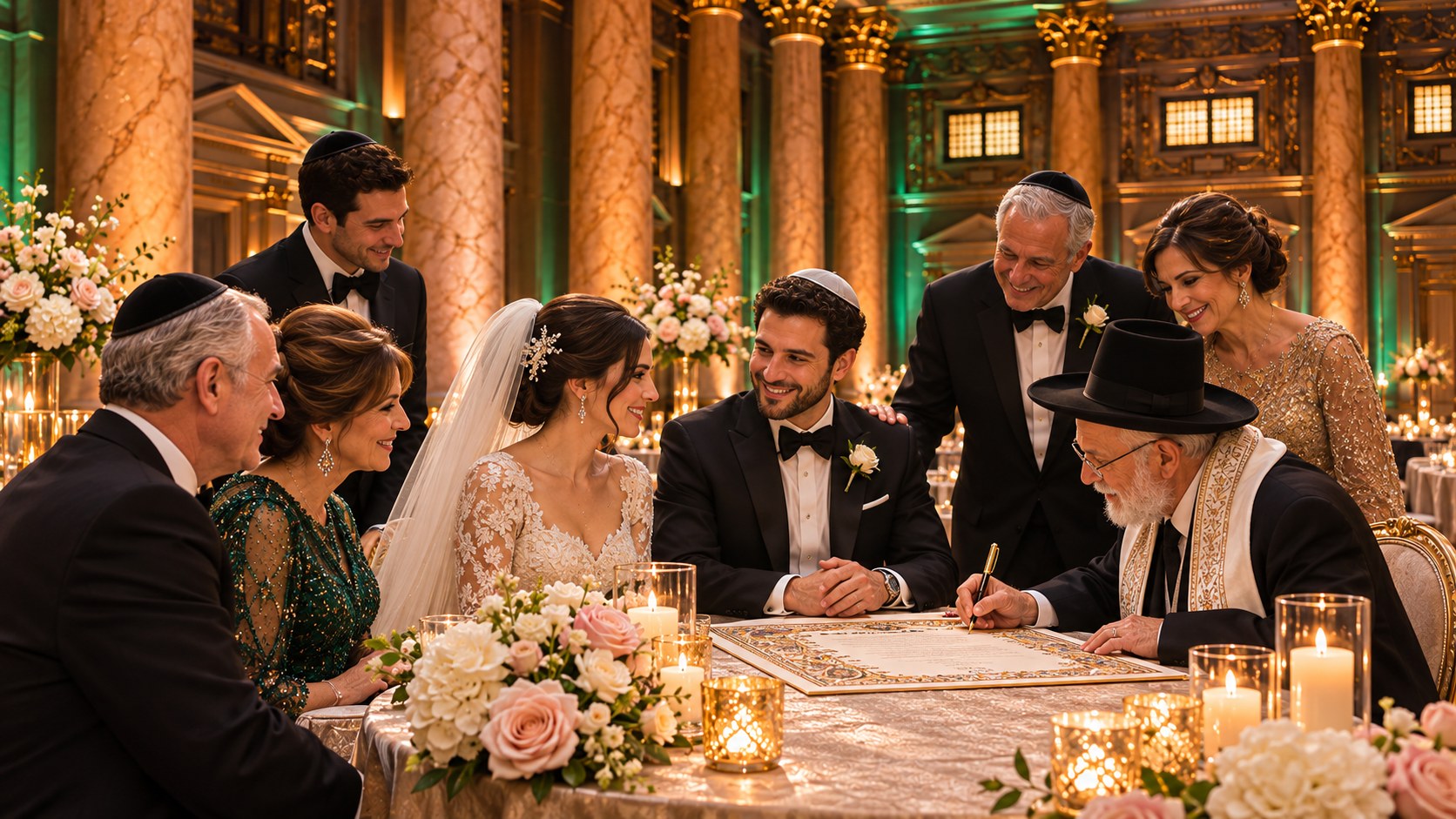
A clear program helps guests follow the celebration. Jewish weddings include moments that may be unfamiliar to some guests — the chuppah, the ketubah signing, the hora. A brief printed or digital program explaining the sequence and meaning of each part helps everyone feel included and engaged.
- Collect dietary needs from guests and share them with the caterer early.
- Plan seating that reflects your community's customs.
- Confirm accessibility for elderly and disabled guests.
- Arrange parking, valet, and transportation for out-of-town guests.
- Coordinate Shabbat and holiday travel according to guests' practices.
- Reserve hotel room blocks near the venue for traveling guests.
- Provide a clear program so guests understand the ceremony and reception flow.
Dietary Communication
Dietary needs are easier to accommodate when they are known early. Build a process for collecting and confirming them so the caterer has time to plan.
- Ask guests about dietary needs on the invitation or RSVP.
- Share confirmed needs with the caterer in writing at least two weeks out.
- Label dishes clearly at service so guests can choose confidently.
- Confirm allergy-accommodating options are prepared under supervision.
Seating and Accessibility
Seating and accessibility shape how comfortable every guest feels. Plan both with your community's customs and your guests' needs in mind.
Separate seating where observed
If your community observes separate seating during dancing or the meal, confirm the venue can support the layout and that table assignments reflect it.
Step-free access and elevators
Confirm step-free entry, elevator access to all used floors, and accessible restrooms. Walk the route a guest with limited mobility would take.
Comfortable seating for all ages
Provide seating that accommodates elderly guests and families with young children, including highchairs where needed.
Questions to Ask Before You Book
Use these questions to evaluate any venue for jewish wedding sheva brachot venues in NYC. The answers help you compare options honestly and avoid venues that cannot support your celebration's requirements.
Bring these questions to every venue tour and ask for written answers. A venue that cannot answer them clearly may not be the right fit, no matter how beautiful the space. Share the answers with your rabbi before you sign a contract.
Documenting the answers lets you compare venues side by side rather than relying on memory. Create a simple spreadsheet or checklist with each venue's responses, and revisit it after every tour. The venue that seemed perfect in the moment may reveal gaps when you review the written answers later.
Pay special attention to how a venue responds to questions about kosher supervision. A venue that is forthcoming, detailed, and willing to put arrangements in writing is generally easier to work with than one that is vague or evasive. The quality of the answers often reflects the quality of the working relationship you will have.
Do not be afraid to ask follow-up questions. A first answer may be incomplete, and a reputable venue will welcome the chance to clarify. If a venue resists detailed questions, treat that as a signal about how the relationship will unfold.
- What kosher supervision arrangements can this venue support?
- Is an outside kosher caterer permitted, and under what conditions?
- Can the kitchen be kashered, or must the caterer bring all equipment?
- Who provides the mashgiach, and what access do they have?
- Can the venue accommodate a mechitza, yichud room, and chuppah?
- What are the seated and standing capacities under our preferred layout?
- What is the venue's experience hosting Jewish weddings?
- What are the load-in, setup, and breakdown times and fees?
- Is the venue accessible, and what parking is available?
- Can we see a current kosher certification letter before booking?
- What is the latest end time for the reception, and are there noise restrictions?
- What is included in the rental, and what costs extra?
Kosher-Specific Questions
These questions get at the heart of whether a venue can support a kosher celebration. Prioritize them, because the answers determine feasibility.
- Which certifying agency currently supervises the venue or caterer?
- Can we see the current certification letter and verify its scope?
- Who provides the mashgiach, and will they be on site throughout?
- What kashering or equipment arrangements apply to our event?
Logistical and Contractual Questions
Beyond kosher, the practical terms of the rental shape your experience and your budget. Confirm them in writing before signing.
Capacity and layout
Ask for effective capacity under your layout, including space for the chuppah, dance floor, and mechitza where relevant.
Timing and fees
Confirm load-in, setup, and breakdown windows, and any overtime or late-night fees. Understand what is included and what costs extra.
Accessibility and parking
Confirm step-free access, elevators, accessible restrooms, and parking or valet arrangements for your guests.
Coordinating with Your Rabbi and Supervisory Authority
Throughout planning jewish wedding sheva brachot venues in NYC, your rabbi and chosen kosher supervisory authority are your most important advisors on religious requirements. Consult them early and often.
Your rabbi can advise on which customs your celebration should include, which kosher supervision standard your community accepts, and how to handle Shabbat and holiday timing. Share venue and caterer documentation with your rabbi for review before you commit.
When a decision involves religious requirements, this guide recommends confirming details with your rabbi or chosen kosher supervisory authority. The information here is educational and does not constitute a halachic ruling. Every family and community is different, and the right answer depends on your specific practices.
The supervising authority (hashgacha) plays a role distinct from your rabbi. Your rabbi guides the couple and the ceremony; the hashgacha oversees the food. In some cases your rabbi and the hashgacha are from the same organization; in others they are separate. Clarify who is responsible for what, and make sure both are in communication well before the event.
Bring your rabbi into the conversation before you sign contracts, not after. A venue or caterer that looks suitable on paper may raise concerns your rabbi identifies from experience. Early review gives you time to adjust course before deposits are paid.
- Consult your rabbi before booking any venue or caterer.
- Share kosher certification documentation for review.
- Confirm which customs your celebration will include.
- Discuss Shabbat and holiday timing constraints.
- Verify the supervisory authority your community accepts.
- Clarify the roles of rabbi, mashgiach, and hashgacha.
- Involve your rabbi before contracts are signed, not after.
The Rabbi's Role
Your rabbi guides the couple and the ceremony — which customs to include, how to time the celebration, and which supervision standard your community accepts.
- Advise on which customs your celebration should include.
- Review venue and caterer documentation before you commit.
- Guide Shabbat and holiday timing decisions.
- Confirm which certifying authorities your community accepts.
The Supervisory Authority's Role
The hashgacha oversees the food — ingredient sourcing, kitchen arrangements, and on-site supervision. Understand how it complements your rabbi's guidance.
Certifying the operation
The hashgacha certifies that the caterer or venue kitchen meets kosher standards and issues the certification letter you verify.
Providing the mashgiach
The hashgacha appoints a mashgiach to supervise preparation and service on site. Confirm who provides the mashgiach for your event.
Coordinating with your rabbi
In some communities the rabbi and hashgacha are the same body; in others they are separate. Ensure both are aligned before the event.
Budget and Timeline Considerations
Planning jewish wedding sheva brachot venues in NYC requires a realistic budget and a timeline that accounts for kosher supervision, vendor coordination, and the NYC venue market's competitive booking windows.
NYC kosher weddings typically cost more than non-kosher weddings of the same scale because kosher supervision, certified ingredients, separate equipment, and mashgiach staffing all add to the per-guest cost. Build these costs into your budget from the start so they do not surprise you later. A standard kosher wedding in NYC might range from $150 to $400 per guest for catering and venue combined, with luxury venues and peak-season dates at the higher end.
The timeline for booking a kosher wedding venue in NYC is often longer than couples expect. Peak-season dates (May through October, especially June and September) book 12 to 18 months in advance at popular venues. Off-season and weekday dates may be available 6 to 9 months out. Begin venue research early, but confirm kosher supervision arrangements before signing any contract — a beautiful venue that cannot support your kosher requirements is not a viable option.
Build contingency into both budget and timeline. Kosher logistics can introduce unexpected costs — additional kashering fees, extra mashgiach hours, or premium ingredients — and a buffer prevents a small surprise from becoming a crisis. Similarly, allow extra planning time for supervision arrangements that take weeks to confirm.
Use the interactive budget estimator on this page to explore an illustrative range for your guest count and style. Treat the result as a starting point for conversations with venues and caterers, then request written quotes that reflect your specific requirements.
- Budget for kosher supervision, certified ingredients, and mashgiach staffing.
- Expect $150–$400 per guest for catering and venue combined in NYC.
- Book peak-season venues 12–18 months in advance.
- Consider off-season or weekday dates for more availability and lower costs.
- Confirm all costs in writing before signing a contract.
- Build a contingency buffer for unexpected kosher logistics costs.
- Allow extra planning time to confirm supervision arrangements.
Building a Realistic Budget
A realistic kosher wedding budget accounts for costs that do not appear in a standard wedding budget. Identify them early so your estimates are honest.
- Kosher supervision and mashgiach staffing fees.
- Certified ingredients, which can cost more than standard equivalents.
- Separate equipment and kashering where applicable.
- Outside caterer fees or premiums charged by the venue.
Working with NYC Booking Windows
NYC venues book on predictable cycles. Aligning your timeline with those cycles improves your options and your negotiating position.
Peak season
May through October, especially June and September, is peak season. Popular venues book 12 to 18 months ahead, and dates disappear quickly.
Off-season and weekdays
November through March and weekday dates offer more availability and lower costs, which can free budget for kosher logistics.
Confirm supervision before signing
No matter the season, confirm kosher supervision is feasible before signing a venue contract. A date is only useful if the venue can support your celebration.
Related Planning Resources
Frequently Asked Questions
Practical answers to common questions about kosher wedding venue planning in New York City. Customs and requirements vary among families, communities, and supervising authorities — confirm details with your rabbi and chosen kosher supervisory authority.
Ready to explore kosher wedding venues in NYC?
Share your celebration details and we will help you identify venues, caterers, and planning resources suited to your needs.